
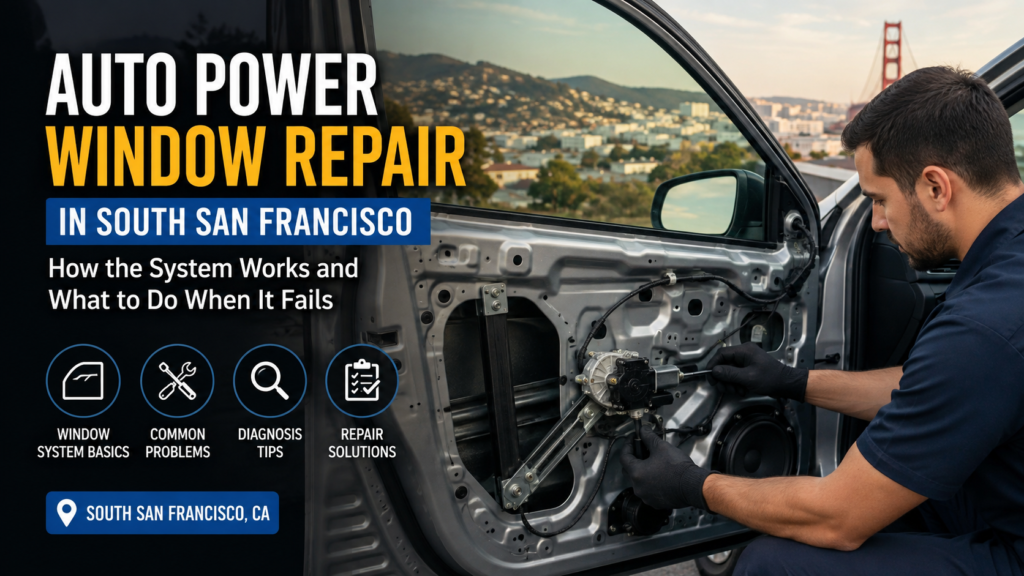
Power windows are standard equipment on virtually every vehicle sold in the United States today a convenience so thoroughly integrated into daily driving that most drivers give them no thought until one stops working. When a window fails to move, moves erratically, makes grinding or clicking noises, or gets stuck in the open position in South San Francisco’s frequent fog and rain, the problem demands prompt attention. Understanding how power window systems work, what causes them to fail, and how professional technicians diagnose and Auto Power Window Repair South San Francisco them helps South San Francisco drivers make informed decisions when this common automotive problem occurs.
How Power Windows Work
A power window system consists of several interconnected components that must all function properly for the window to operate smoothly. The window glass itself sits in a track within the door and is mechanically connected to a window regulator the mechanical linkage system that converts the rotational output of the window motor into the up-and-down translational motion of the glass.
The window motor is an electric motor that provides the rotational force that drives the regulator. In most modern vehicles, the motor and regulator are integrated into a single assembly, meaning that if either component fails, the entire assembly typically needs replacement. In some older or simpler vehicle designs, the motor can be replaced independently of the regulator.
The window switch typically located on the door armrest for each individual window, and on the driver’s master control panel for all windows simultaneously sends an electrical signal to the window motor when the driver or passenger operates it. The window module (in vehicles with electronic window control systems) interprets the switch input and controls motor operation, including features like auto-up and auto-down with pinch protection. Wiring, connectors, and fuses complete the electrical circuit from the vehicle’s power supply through the switch, module, and motor.
Common Causes of Power Window Failure in South San Francisco Vehicles
Window motor failure is the most common cause of a power window that will not move in either direction. Motors fail through several mechanisms: worn brushes that can no longer make adequate contact with the commutator, failed bearings that allow the motor to seize, and winding failures from overheating. An overheated motor is a specific concern in South San Francisco’s Bay Area climate vehicles that sit in direct sun in parking lots along the East Grand Avenue biotech corridor during summer months can develop significant interior heat, and repeatedly operating the windows when the motor is already warm can push it to its thermal limit.
Window regulator failure typically presents as a window that moves slowly, makes grinding or clicking sounds, moves unevenly (one side of the glass rising faster than the other), or drops suddenly within the door. Cable-type regulators in which a cable and pulley system drives the glass commonly fail through cable fraying or breakage. Scissor-type and X-arm regulators fail through pivot wear and deformation of the arms. A window that suddenly falls into the door with a loud clunk has typically experienced a cable break or regulator arm failure.
Electrical failures blown fuses, failed relays, faulty wiring connections, and corroded connectors can cause power window symptoms without any mechanical component failure. These are often intermittent problems the window works sometimes but not others because a corroded connector may make adequate contact under some temperature and humidity conditions but not others. South San Francisco’s Bay Area climate, with its frequent fog and moisture, creates conditions that accelerate electrical connector corrosion in vehicles that spend significant time parked outdoors.
Window switch failure causes one or more windows to be inoperable from one specific switch location. If the driver’s window works from the driver’s master switch but not from the door-mounted switch, the door switch has likely failed. If all windows are inoperable from the driver’s master switch but individual door switches still work, the master switch or its wiring is the likely culprit.
How Technicians Diagnose Power Window Problems
Professional power window diagnosis begins with a systematic electrical check before any mechanical disassembly. The technician actuates the switch and listens for the sound of the motor attempting to operate a sound but non-moving window indicates mechanical failure, while no sound at all indicates an electrical problem. Checking the fuse for the window circuit is the first step when there is no sound; a blown fuse is the simplest possible cause and the first thing to rule out.
If the fuse is intact, the technician observes the interior dome light while operating the window switch. If the dome light dims slightly when the switch is pressed, current is reaching the motor and the motor is drawing power but not producing motion indicating motor or mechanical failure. If the dome light does not dim, current is not reaching the motor, indicating a switch, wiring, or connector fault.
For final mechanical diagnosis, the door trim panel must be removed to access the regulator and motor assembly. With the panel off, the technician inspects the regulator for visible damage, checks the motor wiring harness connector for corrosion, and in some cases uses a scan tool to read window control module fault codes in vehicles with electronic window management systems.
The Power Window Repair Process
Motor and regulator replacement the most common power window repair requires careful disassembly of the door interior. The technician removes the interior door trim panel by releasing retaining clips around the perimeter and disconnecting any electrical connectors for the switches, lights, or speakers mounted in the panel. The door vapor barrier (a plastic film that seals the interior of the door against moisture) is peeled back to access the window mechanism inside the door cavity.
The window glass is disconnected from the regulator a process that can be challenging if the regulator or motor have failed with the window in a position that makes disconnection difficult. In some cases, the glass must be taped or supported while the regulator is removed. The failed regulator and motor assembly is unbolted from the door structure and the new assembly is installed in its place. The glass is reconnected to the new regulator, and the system is tested before the door panel is reassembled.
Proper glass alignment within the door frame is critical for correct window operation after repair. If the glass is not correctly aligned in its tracks, the window may bind, rattle while the vehicle is moving, or not seal properly against the weatherstripping when fully closed. Experienced technicians take time with the alignment step and test window operation through multiple complete up-and-down cycles before closing the door panel.
Common Questions About Auto Power Window Repair in South San Francisco
Can a power window that is stuck in the down position be temporarily secured? Yes. If a window is stuck open, a temporary cover using heavy-duty plastic sheeting and tape provides weather protection until professional repair can be scheduled. In South San Francisco’s marine climate with frequent fog and occasional rain, securing an open window promptly protects the vehicle interior from moisture damage.
Is it possible to fix only the window motor without replacing the entire regulator assembly? In some vehicles, the motor can be separated from the regulator and replaced independently. In many modern vehicles, the motor and regulator are integrated as a single unit and must be replaced together. A technician who has assessed your specific vehicle can advise whether motor-only replacement is feasible.
Can a power window fuse be replaced without a shop visit? Yes. If a window stops working suddenly with no grinding noise, the fuse is the first thing to check. The fuse box location is shown in the vehicle owner’s manual, and window fuses are typically labeled in the fuse box cover diagram. Replacing a blown fuse costs only the price of the fuse. If the replacement fuse blows again immediately, there is an underlying electrical fault that requires professional diagnosis.